Integration Techniques
Many integration formulas can be derived directly from their corresponding derivative formulas, while other integration problems require more work. Some that require more work are substitution and change of variables, integration by parts, trigonometric integrals, and trigonometric substitutions.



Example 1: Evaluate 
Using formula (4) from the preceding list, you find that 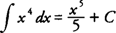 .
.
.
Example 2: Evaluate  .
.
.
Because  using formula (4) from the preceding list yields
using formula (4) from the preceding list yields
|

Example 3: Evaluate 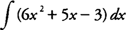
Applying formulas (1), (2), (3), and (4), you find that
|

Example 4: Evaluate 
Using formula (13), you find that 
Example 5: Evaluate 
Using formula (19) with a = 5, you find that
|

Substitution and change of variables
One of the integration techniques that is useful in evaluating indefinite integrals that do not seem to fit the basic formulas is substitution and change of variables.This technique is often compared to the chain rule for differentiation because they both apply to composite functions. In this method, the inside function of the composition is usually replaced by a single variable (often u). Note that the derivative or a constant multiple of the derivative of the inside function must be a factor of the integrand.
The purpose in using the substitution technique is to rewrite the integration problem in terms of the new variable so that one or more of the basic integration formulas can then be applied. Although this approach may seem like more work initially, it will eventually make the indefinite integral much easier to evaluate.
Note that for the final answer to make sense, it must be written in terms of the original variable of integration.
Example 6: Evaluate 
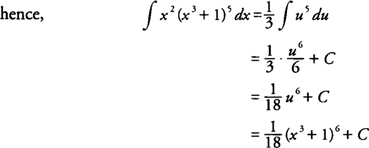
Because the inside function of the composition is x3 + 1, substitute with
|

|
Example 7: 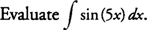
Because the inside function of the composition is 5 x, substitute with
|
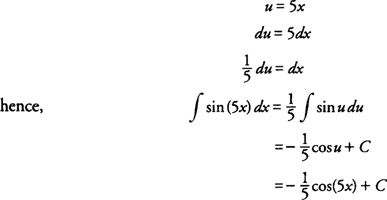
Example 8: Evaluate 
Because the inside function of the composition is 9 – x2, substitute with
|

Integration by parts
Another integration technique to consider in evaluating indefinite integrals that do not fit the basic formulas is integration by parts. You may consider this method when the integrand is a single transcendental function or a product of an algebraic function and a transcendental function. The basic formula for integration by parts is
|
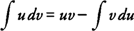
where u and v are differential functions of the variable of integration.
A general rule of thumb to follow is to first choose dv as the most complicated part of the integrand that can be easily integrated to find v. The u function will be the remaining part of the integrand that will be differentiated to find du. The goal of this technique is to find an integral, ∫ v du, which is easier to evaluate than the original integral.
Example 9: Evaluate ∫ x sec2 x dx.
|

Example 10: Evaluate ∫ x4 In x dx.
|

Example 11: Evaluate ∫ arctan x dx.
|

Trigonometric integrals
Integrals involving powers of the trigonometric functions must often be manipulated to get them into a form in which the basic integration formulas can be applied. It is extremely important for you to be familiar with the basic trigonometric identities, because you often used these to rewrite the integrand in a more workable form. As in integration by parts, the goal is to find an integral that is easier to evaluate than the original integral.
Example 12: Evaluate ∫ cos3 x sin4 x dx
|

Example 13: Evaluate ∫ sec6 x dx
|

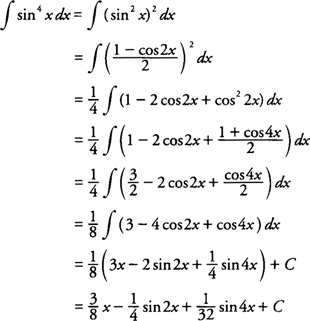
Example 14: Evaluate ∫ sin4 x dx
|
Trigonometric substitutions
If an integrand contains a radical expression of the form a specific trigonometric substitution may be helpful in evaluating the indefinite integral. Some general rules to follow are
a specific trigonometric substitution may be helpful in evaluating the indefinite integral. Some general rules to follow are- If the integrand contains


- If the integrand contains


- If the integrand contains

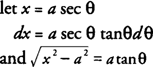
Right triangles may be used in each of the three preceding cases to determine the expression for any of the six trigonometric functions that appear in the evaluation of the indefinite integral.
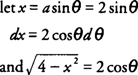
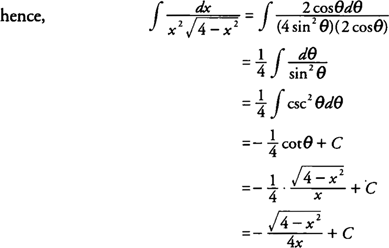
Example 15: Evaluate 
Because the radical has the form 
|
| |||
| |||

|
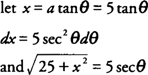
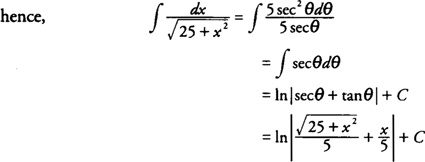
Example 16: Evaluate 
Because the radical has the form 
|
| |||
| |||

|
AREA UNDER A CURVE
Area Integral Approximations
The area under any continuous curve can be approximated by drawing a number of rectangles. The integral is the limit for an infinite number of rectangles.
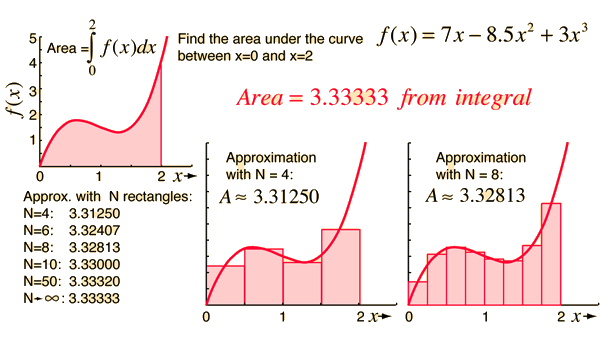
Area Integral Example
Integrals are useful for finding the area under curves which can be approximated by geometrical methods.
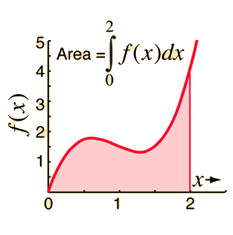 |  |
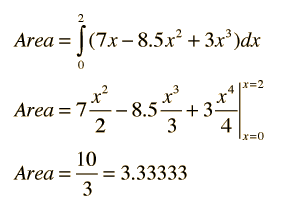
The area under a curve between two points can be found by doing a definite integral between the two points.
To find the area under the curve y = f(x) between x = a and x = b, integrate y = f(x) between the limits of a and b.

Areas under the x-axis will come out negative and areas above the x-axis will be positive. This means that you have to be careful when finding an area which is partly above and partly below the x-axis.

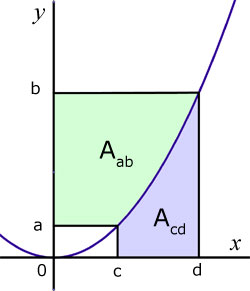
You may also be asked to find the area between the curve and the y-axis. To do this, integrate with respect to y.
Example
Find the area bounded by the lines y = 0, y = 1 and y = x2.

Area under a curve related to different axes

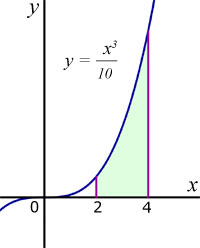
Example #1
Find the area 'A' enclosed by the x-axis, x=2, x=4 and the graph of y=x3/10.

Positive and negative area
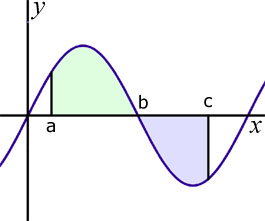

note: This expression calculates the absolute area between the curve the vertical lines at 'a' and 'b' and the x-axis. It takes no account of sign. If sign were an issue then the two integrals on the first line would be added and not subtracted.
Unless told differently, assume that the absolute area is required.
Example #1
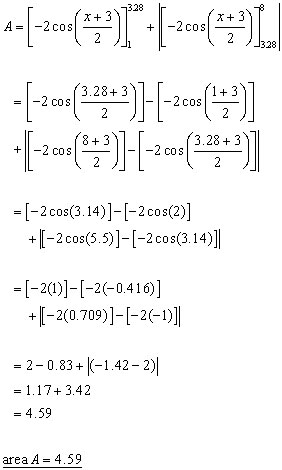
Find the area 'A' enclosed by the x-axis, x=1, x=8 and the graph of y=2sin[(x+3)/2].
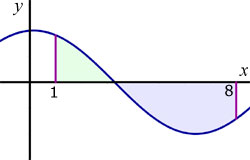
The curve crosses the x-axis at y=0.
Therefore 2sin[(x+3)/2]=0
Sine is zero when the angle is 0,180 or 360 deg.
(zero, pi and 2 pi)


Area bounded by two curves
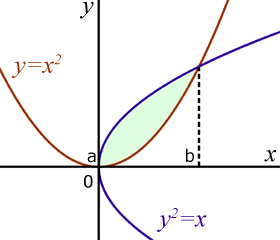

Example #1
To 3 d.p. calculate the area 'A' included between the curves y=x2/2 and y=(0.75)x
first find the x value where the curves cross

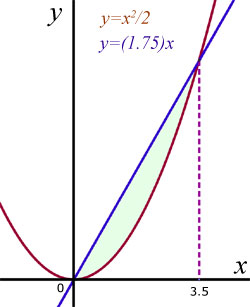
The area 'A' is the difference between the area under the straight line and the area under the parabola, from x=0 to x=3.5 .

1. Volume of a wine cask

A wine cask has a radius at the top of 30 cm and a radius at the middle of 40 cm. The height of the cask is 1 m. What is the volume of the cask (in L), assuming that the shape of the sides is parabolic?
We will lay the cask on its side to make the algebra easier:

We need to find the equation of a parabola with vertex at (0,40) and passing through (50,30) .
We use the formula:
(x − h)2 = 4a(y − k)
Now (h, k) is (0, 40) so we have: x2 = 4a(y − 40) and the parabola passes through (50, 30), so
(50)2 = 4a(30 − 40)
2500 = 4a(−10) and this gives 4a = −250
So the equation of the side of the barrel is
x2 = -250(y − 40), that is,
y=−x2250+40
We need to find the volume of the cask which is generated when we rotate this parabola between x = -50 and x = 50 around the x-axis.

Now, since
(−50)5 = −505,
(−50)3 = −503, and
(−50) = −50,
we can reduce the amount of writing somewhat and put:
So the wine cask will hold 425.2 L
2. Volume of a watermelon

Interestingly, Archimedes (the one who famously jumped out of his bath
and ran down the street shouting "Eureka! I've got it") used this approach
to find volumes of spheres around 200 BC. The technique was almost
forgotten until the early 1700s when calculus was developed by Newton
and Leibniz.
and ran down the street shouting "Eureka! I've got it") used this approach
to find volumes of spheres around 200 BC. The technique was almost
forgotten until the early 1700s when calculus was developed by Newton
and Leibniz.
We see how to do the problem using both approaches.
Volume using historical method:

Because the melon is symmetrical, we can work out the volume of one half of the melon,
and then double our answer.
The radii for the slices for one half of a particular watermelon are found from measurement
to be:
The approximate volume for one half of the melon using slices 2 cm thick would be:
So the volume for the whole watermelon is about
"Exact" Volume (using Integration):
We are told the melon is an ellipsoid. We need to find the equation of the cross-sectional ellipse with major axis 28 cm and minor axis 25 cm.
We use the formula (from the section on ellipses):
x2a2+y2b2=1
where a is half the length of the major axis and b is half the length of the minor axis.
For the volume formula, we will need the expression for y2 and it is easier to solve for this now (before substituting our a and b).
x2a2+y2b2=1b2x2+a2y2=a2b2a2y2=a2b2−b2x2=b2(a2−x2)y2=b2a2(a2−x2)
Since a=14 and b=12.5 , we have:
NOTE: The a and b that we are using for the ellipse formula are not the same a and b we use in the integration step. They are completely different parts of the problem.
Using this, we can now find the volume using integration. (Once again we find the volume for half and then double it at the end).
